

How To Draw Details In Revit
8 Tips To Create Beautiful Drawings In Revit
Most architects call back that Revit is a terrible presentation tool. They are wrong. And this guide is going to show information technology. You don't need sketchup or Photoshop to create interesting conceptual documents.
If you like creating beautiful views, make sure to check out our brand new mysterious, sensual learning package chosen Blueprint .
In this post, we are going to use the project provided by a Revit Pure reader: Wolfgang Sirtl. The name of the project is: Beckerstraße. It is a 17 apartments edifice in Ingolstadt, s Germany. Check out this business firm website over here: http://www.qsp-architekten.de/
Enough babbling! Let's get started.
1- Accommodate LINE WEIGHT
A mutual criticism of Revit is the difficulty to suit the line weight of elements, especially in elevations and 3D views. In the plan view below, you can see that the line thickness hierarchy is non great… the cartoon appears flat. The cutting walls line thickness is set to 4, meaning information technology volition print at .35mm. That's pretty thin.

Let'due south become to the Line Weights carte du jour. Go to the Additional Settings dropdown carte in the Manage tab. Select the Line Weights tool. Conform the number four thickness for the correct scale. In the example beneath, we boost the thickness to 0.5mm. The drawing looks much improve!

The Line Weights bill of fare is not the merely style to affect the thickness. The Linework tool (shortcut: LW) allows you to supervene upon the fashion of a single line. In the case below, nosotros override a 3D border to a royal dashed line. Drag the bluish dot to adjust the line override boundary.

2- Sympathize WHICH VISUAL Fashion TO Utilise
Revit offers half dozen unlike visual styles. Recollect carefully virtually which one to use. For conceptual views, Consequent Colors is ofttimes a neat selection. Hidden Lines might too be interesting. When y'all are set up for images that are more realistic, the Realistic style and rendering.

A confusing feature of Revit is the difference between the Graphics and Appearance properties of a material. The settings in Graphics volition be used in Wireframe, Hidden Lines, Shaded and Consistent Colors styles. The appearance settings, where yous can set paradigm textures, are used for Realistic, Raytrace and renderings.
In the image beneath, nosotros adjust a brick material. In the Graphics tab, we set a line pattern and a color to exist used in shaded/consistent colors visual style. In the appearance tab, we set an actual brick texture image.
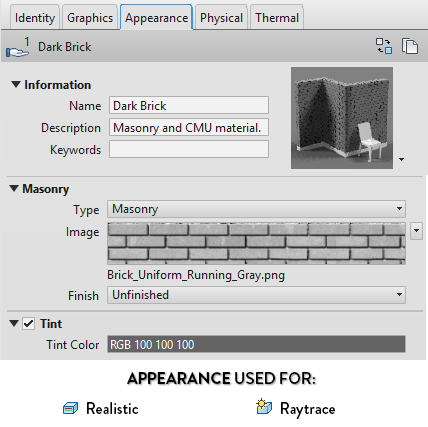
Every bit you tin run into below, Consistent Colors volition display materials using line pattern, while Realistic will brandish the fabric using epitome textures.

iii- CREATE A POCHE CUT Way
For presentation documents, you probably don't want to meet a agglomeration of wall and floors layers. For instance, this is what a "default" department-perspective will look like.

To requite more punch to this drawing, let's create a poche for all walls, floors, roofs and columns elements. Go to the Visibility/Graphics menu by using shortcut VG. Set a dark solid color fill up for the cutting blueprint of all elements, except topography.

Equally you lot can come across below, the drawing is of a sudden more much interesting.

This technique tin besides be used in regular sections and plan views.
4- Principal THE SHADOWS
Time to employ your dark wizardry skills to create shadows.
There is 2 types of shadows in Revit: Cast Shadows and Ambient Shadows.
You can click on the small sphere icon at the bottom of your screen to activate cast shadows. Merely the best way to practice it is to go to the Graphic Display Options carte by clicking on the cube at the bottom of your screen.

Woah! That'south way too dark. Go back to Graphic Brandish Options bill of fare and then to the Lighting submenu. Prepare the shadows intensity between 10 and 15.

Better. But we demand Ambient Shadows. Go back to the shadows submenu and activate the choice.

That'due south it! Now that'southward a proficient looking view. The only problem with Ambience Shadows is that you can't command the intensity of the effect. In blackness and white views, it sometimes turn out to be as well intense.
Hey bro! Don't forget to check out the DESIGN learning bundle. It's the result of 2 years of enquiry and experimentation to help you create beautiful, gorgeous drawings using Revit.
5- ACTIVATE ANTI-ALIASING
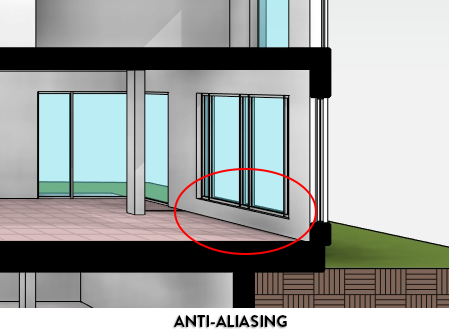
Aliasing occurs in a drawing when angled lines appear pixelated. Become to the Graphic Brandish Options card. Under "Model Display", bank check the "Smooth lines with anti-aliasing" box.


half-dozen- USE CUSTOM ENTOURAGE
The default copse and entourage characters in Revit are not pretty. If y'all want to prove people in your views without having to use Photoshop, your all-time bet is to create or download custom families.
In the example beneath, we populate the section-perspective with default Revit entourage RPC families. Yuck.

Let'due south set the image past using custom made entourage families. Improve, isn't it?
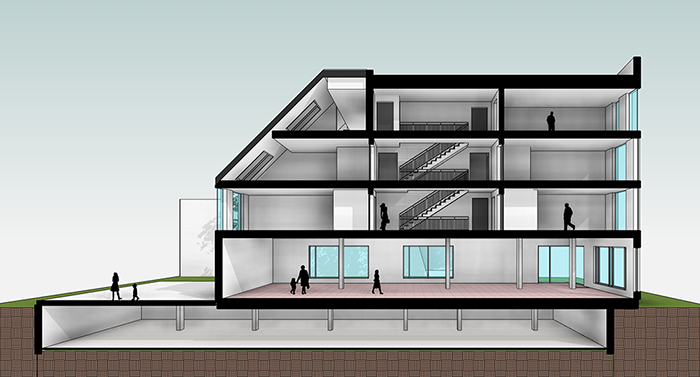
Our DESIGN packet teaches you how to create custom entourage families. It besides contains some of them to make your views improve.
7- Empathize HOW TO USE GRAPHIC OVERRIDES
Past default, the graphic styles of all model elements are controlled by the Object Way menu and the material assigned. For example, the wall below has a concrete material assigned, which will determine the patterns. The line thickness is controlled in the Object Style menu, located in the Manage tab

What if you want to modify the visual manner of this wall, but only in a specific view? That's when yous have to use overrides. In the epitome beneath, we utilise multiple overrides to bear on the graphic display of the wall.

To create presentation documents, you take to apply overrides to affect an entire drawing. This way, yous can accept both a construction programme view and a presentation programme view with completely unlike graphic styles in the aforementioned model.
The chart below explains how Revit decides which tool to prioritize when drawing an chemical element. That means an chemical element with a Linework override will have priority over an element afflicted by a view filter or by a phasing setting. The low priority settings commonly accept a broad effect on the project at large, while the high priority are usually specific to unmarried elements.

For presentation purpose, the Visibility/Graphics menu is useful to overrides all elements in the view. Then, you can make adjustments on specific elements by using tools similar Override Graphics In View and Linework.
8- Utilize COLORED Punch IN BLACK AND WHITE VIEWS
Blackness and white views can exist charming. In theory, the Hidden Lines style is ever black and white. Only it is actually possible to gear up a colored override to a specific chemical element. In the image beneath, we modify the glass material and ready a solid fill surface blueprint in the background. The blueish tint creates an interesting punch to the view.
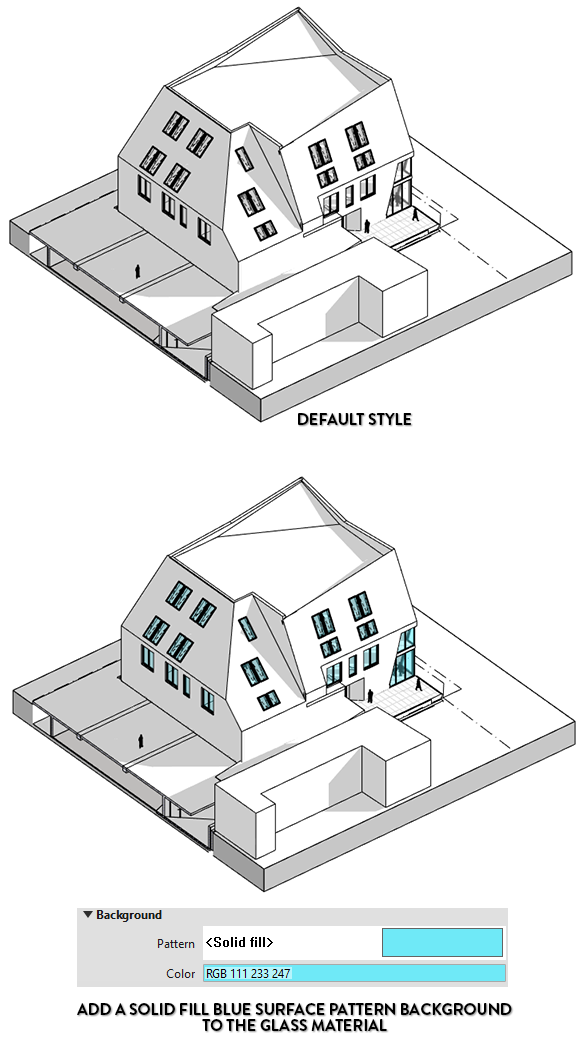
Nosotros're not done my friend. Revit is dark and full of mysteries. Practise you want to unlock more hidden features and unleash space beauty? Check out our Design package. It contains tips to principal Revit graphic features. You will too learn how to create cute materials, gorgeous renderings and much more than. Download the sample chapter about 3D views.


Source: https://revitpure.com/blog/8-tips-to-create-beautiful-drawings-in-revit
Posted by: morristhadell.blogspot.com
0 Response to "How To Draw Details In Revit"
Post a Comment